
Protecting Your Wallet & Your Rights Resources
Staying financially secure and safe online is an important part of aging well. On Tuesday, January 27, 2026, our Active Aging Series welcomed community experts who shared practical, up-to-date information to help seniors recognize scams, protect personal information, and feel more confident using technology.
This session focused on real-world scams affecting Canadians today and offered clear steps seniors can take to protect themselves.
Below are some of the key points shared in each presentation.
Understanding Utilities in Alberta & Avoiding Utility Scams
Presented by Ashley White, Jr. Education and Engagement Specialist
Ministry of Affordability and Utilities, Government of Alberta
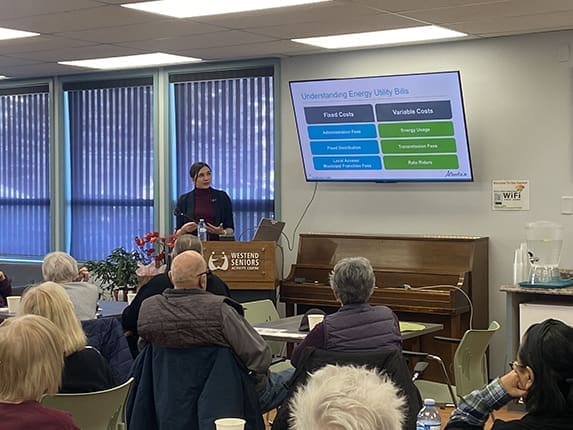
The presentation began by helping seniors better understand how electricity and natural gas services work in Alberta, how to read utility bills, and how to avoid common utility-related scams.
The Utilities Consumer Advocate (UCA) is a free Government of Alberta service that supports consumers by providing education, mediating disputes with utility companies, and representing consumer interests.
Key topics covered included:
- Understanding utility bills, including fixed costs, variable costs, transmission fees, and municipal charges, so seniors know what they are paying for
- Shopping for utilities, including the difference between default service providers and competitive retailers
- An overview of the Rate of Last Resort (RoLR)—what it is, who it applies to, and how to know if you are on it
- Ways to save money by reducing energy use, especially during high-cost winter months
- Utility industry scams, such as fake calls, door-to-door sales tactics, and threats of immediate service disconnection
The presentation also highlighted important winter utility protections:
- Electricity cannot be disconnected from October 15 to April 14
- Natural gas cannot be shut off from November 1 to April 15
An especially helpful takeaway was the UCA Key Takeaways sheet provided by Ashley. This easy-to-read handout summarizes important points, warning signs of scams, consumer rights, and where to get help. It serves as a practical reference seniors can keep at home and revisit whenever questions or concerns about utilities arise.
Seniors were encouraged to contact UCA if they are experiencing difficulties or have concerns about their utility services.
Utilities Consumer Advocate Contact:
310-4UCA (4822) | 1-888-644-6608 (outside Alberta)
Understanding Fraud and Scams
Presented by Lyle Falk, Senior Program Specialist
Service Alberta and Red Tape Reduction
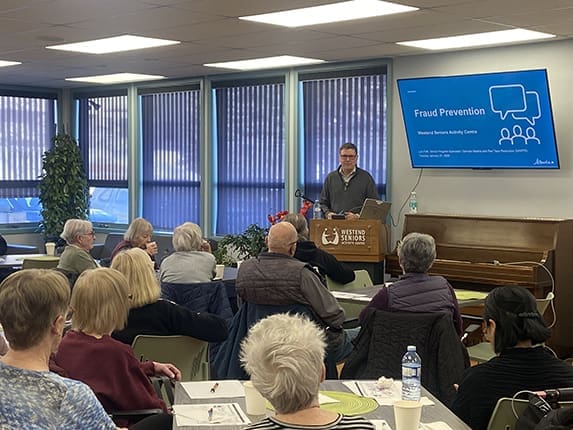
The second presentation explains what fraud really is: intentional deception used to steal money, information, or legal rights. Scams often try to trigger strong emotions such as fear, urgency, or compassion to push people into acting quickly.
Some of the most common frauds affecting Canadians include identity theft, phishing, investment scams, romance scams, and impersonation scams. In 2024 alone, Canadians lost hundreds of millions of dollars to these types of fraud, with seniors being frequent targets.
Common Scams Targeting Seniors
Several real-life examples were discussed, including:
- Emergency or “Grandparent” scams, where callers pretend to be a loved one needing urgent money
- Romance scams, where trust is built online before asking for money or investments
- CRA scams, pretending to collect taxes or penalties
- Bank investigator and tech support scams, claiming your account or computer is compromised
- Extortion emails, threatening harm unless payment is made—often using cryptocurrency
A key reminder shared throughout the session:
If someone pressures you to act immediately, asks for gift cards, or demands secrecy—it is almost always a scam.
How to Protect Yourself
Participants were encouraged to take simple but powerful steps to stay safe:
- Hang up and verify by calling trusted contacts directly
- Never share personal or financial information unless you initiated the contact
- Review bank and credit card statements regularly
- Shred personal documents and collect mail promptly
- Be cautious with links, QR codes, and unexpected messages
When in doubt, pause, don’t respond, and ask for help.
Below are the links mentioned by Lyle in the presentation.
Listing of current scams and a website validator to check if a website is legitimate: https://www.scam-detector.com/
CRA Scam Alert: https://www.canada.ca/en/revenue-agency/corporate/security/protect-yourself-against-fraud/scam-alerts.html
Canadian Anti-Fraud Centre: https://antifraudcentre-centreantifraude.ca/index-eng.htm
Report fraud and cybercrime: https://antifraudcentre-centreantifraude.ca/report-signalez-eng.htm
Consumer and business tips: https://www.alberta.ca/consumer-business-tips
Seniors can contact the Service Alberta and Red Tape Reduction Consumer Contact Centre at 1-877-427-4088 if they have further questions.
Staying Safe Online & Using Technology with Confidence
Presented by Stuart Lee, Director, Stakeholder Engagement CyberAlberta
Cybersecurity Division, Technology and Innovation
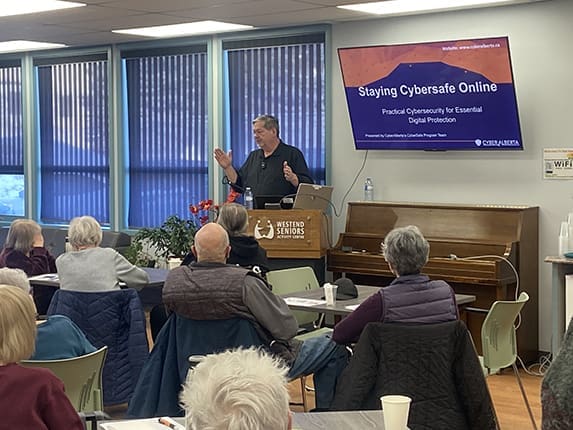
The last part of the session focused on cyber safety and how seniors can protect themselves while using computers, smartphones, and the internet with confidence.
Stuart emphasized that staying safe online does not require advanced technical skills. Instead, a few consistent habits can significantly reduce the risk of fraud, identity theft, and privacy breaches.
Key topics covered included:
- Protecting personal and financial information, such as SIN numbers, health cards, banking details, and online accounts
- Creating strong, unique passwords and using passphrases that are easier to remember
- Using credible password managers to safely store and create strong, unique passwords, making it easier to manage accounts while improving online security.
- Enabling multi-factor authentication (MFA) on important accounts like email, banking, and government services
- Keeping devices up to date with regular software and security updates
- Being cautious when using public Wi-Fi, and avoiding sensitive transactions on unsecured networks
- Understanding when a VPN may be helpful, especially on public networks
- Practicing safe social media habits by limiting personal details and being selective with friend requests
Trusted Resources Shared
Several reliable resources were provided for ongoing support, including:
- Canadian Anti-Fraud Centre – reporting fraud and getting advice
- CRA Scam Alerts – staying informed about tax-related scams
- Service Alberta Consumer Contact Centre – consumer rights and protection
These resources are excellent places to turn if you’re unsure about a situation or need guidance.
Stuart reassured participants that technology can be a helpful and empowering tool when used thoughtfully and safely. He also shared a resource on the Top 5 Password Managers for Seniors, highlighting easy-to-use tools that can significantly improve online security.
MORE ABOUT THE PRESENTING ORGANIZATIONS
Make sure to check their website for more resources!